What Is Route Optimization?
Route optimization is one of those terms that gets used a lot in logistics, but rarely explained clearly. If you run deliveries, manage a fleet or plan routes every morning, you have probably heard it, and you may already be doing parts of it without calling it that. This page explains what route optimization actually means, how it works, why it matters for transport and delivery businesses, and how it differs from ordinary route planning.
What route optimization means
At its simplest, route optimization is the process of working out a sensible way to carry out a set of deliveries with the vehicles you have available. It is not just deciding the order of a few addresses. It is looking at everything that affects the day at once, and organizing it into routes that hold up in the real world.
A good route setup has to take several things into account at the same time:
- The orders that need to be delivered or picked up, and where they are located.
- The vehicles you have available, and how much each one can carry by weight and volume.
- Time windows, when a customer can actually receive a delivery.
- Vehicle working hours, so a route fits inside a realistic working day.
- Travel time between stops, not just distance on a map.
- The order of stops, so drivers are not doubling back across the same area.
- The return to the depot at the end of the route.
On their own, none of these are complicated. The challenge is that they all pull against each other. Grouping stops by area might break a time window. Loading one vehicle fully might leave another half empty. Route optimization is about balancing these factors together, instead of solving them one at a time and hoping the result works out.
How route optimization works
You do not need to understand the maths behind it to use it well. On a practical level, the process usually follows the same steps:
- Orders come in for the day, each with a location and its own requirements.
- The available vehicles are taken into account, along with their capacity.
- Relevant constraints are checked, such as time windows and working hours.
- Orders are divided across the vehicles in a way that fits those constraints.
- The order of stops is worked out for each vehicle to keep the route sensible.
- The routes are calculated, including distance and timing.
- The planner ends up with a workable plan they can review, adjust and send to drivers.
The important part is what happens in the middle. Instead of a planner manually assigning every order and guessing the best sequence, the optimization does that heavy lifting and produces a plan that already respects the constraints that matter. The planner stays in control, but starts from a solid plan rather than a blank page.
Route planning vs. route optimization
These two terms are often used to mean the same thing, but there is a useful difference. Route planning is the broader task of building a route and deciding which stops need to be visited. Route optimization goes a step further and looks at how orders, vehicles and constraints can be organized together to produce a more efficient, more workable plan.
Why route optimization matters
For transport and delivery businesses, the value shows up in the day-to-day running of the operation:
- Less unnecessary driving. Fewer detours and inefficient stop sequences across the day.
- Better use of vehicles. Orders spread more sensibly across the fleet, with capacity taken into account.
- Faster planning. Less manual work for planners, especially as order volumes grow.
- More workable routes. Routes that respect real constraints, so they hold up once drivers are on the road.
- Better fleet efficiency. More done with the vehicles and capacity a business already has, without adding cost.
None of this is about pushing drivers harder. It is about removing the wasted effort that builds up quietly when routes are planned by hand under time pressure.
A simple example
Imagine a transport company with several vehicles and a few dozen orders to deliver in one day. The quick approach is to split the orders across the vehicles more or less evenly and let each driver work through their list. It feels organized, and it gets the work assigned.
But that even split ignores what actually makes a route efficient. One vehicle might be sent back and forth across the city while another stays in a single area. A fully loaded van might be given a delivery it cannot physically fit. A stop with a strict morning time window might sit near the end of a route it can never reach in time.
Route optimization looks at the same orders differently. It considers where each stop is, which vehicle has the right capacity, which deliveries have time windows, how long the working day is, and the order the stops should be visited in. The result is a set of routes that are not just assigned, but actually make sense to drive.
Route optimization for growing delivery businesses
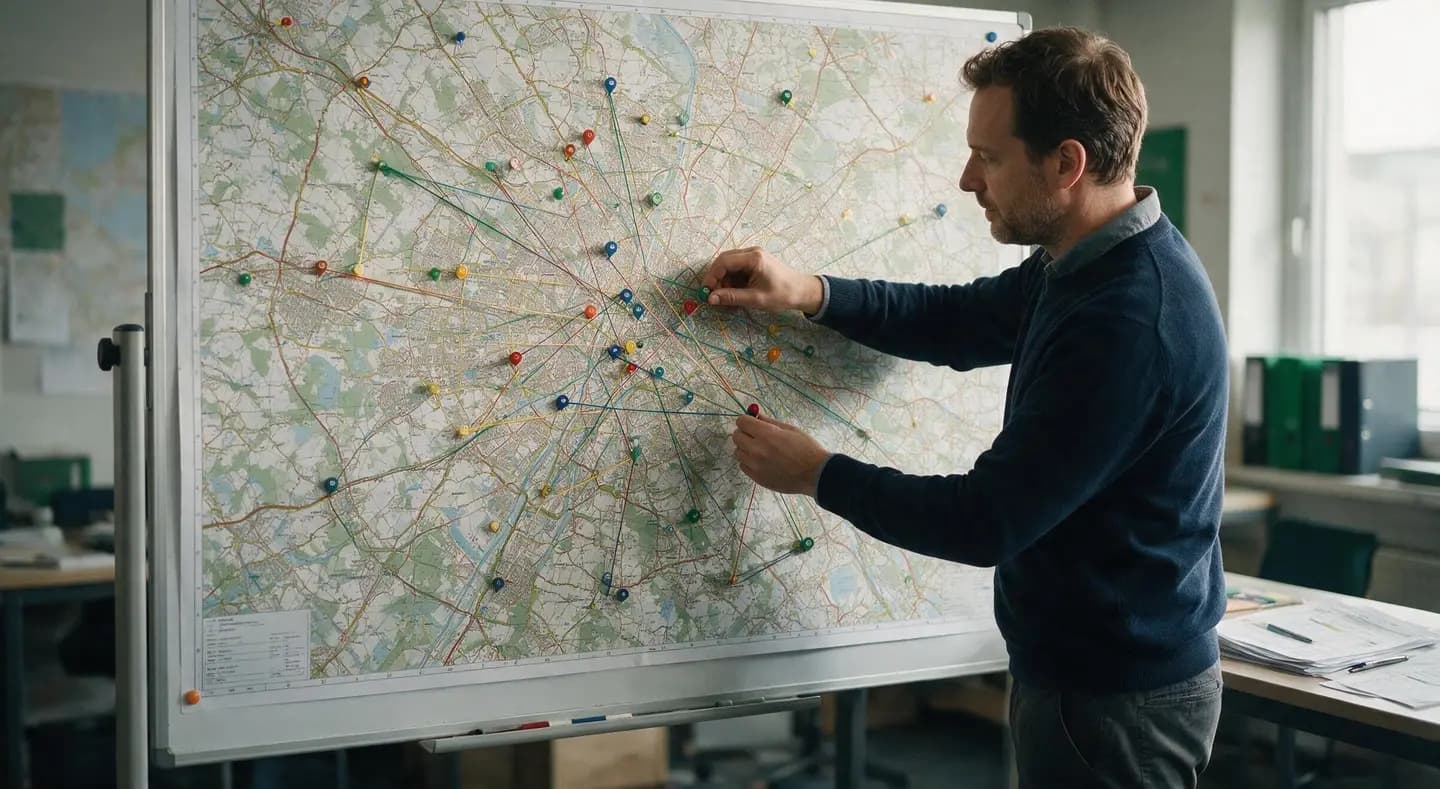
Route optimization is not only for large logistics operations. Plenty of smaller and mid-sized businesses start out with manual planning, a spreadsheet or a basic route planner, and it works fine at first.
The difficulty is that complexity grows quickly. Add more orders, more vehicles, more drivers, more delivery locations and more time windows, and the number of possible combinations rises fast. What used to take ten minutes on paper turns into an hour of juggling, and small mistakes start to cost real time and fuel. This is usually the point where doing it by hand stops being practical, and where optimization starts to pay off.
How PrimoRoute helps
PrimoRoute is a route planning and transport management platform built for transport and delivery businesses. It brings orders, vehicles, drivers, routes and delivery operations together in one place, so the whole day is visible from a single view instead of scattered across tools and spreadsheets.
Route optimization is an important part of the platform. PrimoRoute takes your orders and available vehicles and helps turn them into organized routes, taking relevant planning factors into account, including:
- Vehicle capacity.
- Time windows.
- Vehicle working hours.
- Route sequence.
- Return to the depot.
The aim is straightforward: reduce the manual planning work, make better use of the fleet a business already runs, and produce routes that are practical to carry out. It supports the everyday reality of delivery and transport companies, from a handful of local routes to a busy multi-vehicle operation.