How to Plan Delivery Routes Efficiently
A good delivery route is more than a list of addresses in the order they came in. Efficient planning takes the day’s orders, the locations, the vehicles, the time windows and the practical limits of a working day, and turns them into routes that actually run smoothly on the road. This page walks through what matters when you plan delivery routes, in a practical way you can apply to your own operation.
If you only have a handful of orders, planning by hand works perfectly well. The point where it gets harder is when the numbers grow, and that is exactly where a clear method pays off.
Start with the orders
Good planning starts with a clear picture of the work that actually has to be done. Before you think about routes at all, you need to know what you are planning around:
- How many orders there are for the day.
- Whether each one is a delivery, a pickup, or both.
- Where every stop is located.
- Any time windows the customer has given.
- Relevant order details such as weight, volume and special instructions.
This step is easy to rush, but it sets the ceiling for everything that follows. If the input is incomplete or wrong, the plan built on top of it will be too. A missing time window or an inaccurate address does not stay a small problem; it turns into a failed delivery or a driver stuck waiting. Clean, complete order information is the foundation of an efficient route.
Group stops logically
Once you know the orders, the natural next step is to group stops that are near each other. This keeps drivers working through one area at a time instead of criss-crossing the city and doubling back, which is one of the biggest sources of wasted time and fuel.
But grouping by location alone is not always enough. A geographically perfect cluster can fall apart the moment one of those stops has a tight time window. If two nearby deliveries need to happen at opposite ends of the day, putting them in the same block does not help. Good grouping considers where stops are and when they need to happen, together.
Consider vehicle capacity
When you have more than one vehicle, where the orders are is only half the picture. You also have to think about what each vehicle can actually carry:
- Weight capacity, the maximum load a vehicle can take.
- Volume capacity, how much physical space is available.
- What is already loaded, and what room is left.
This is why splitting orders purely by stop count can mislead. Ten light parcels and ten heavy pallets are both “ten stops”, but not the same job. A vehicle can look balanced on paper and still be overloaded. Efficient planning matches the work to a vehicle that can handle it.
Respect delivery time windows
A time window is simply the period when a customer can actually receive a delivery. They matter because they can shape the entire order of a route, not just one stop.
Take a simple case. One customer can only receive between 10:00 and 12:00; another is closer to the depot but open all day. The nearer stop feels like the obvious first choice, but the strict window may have to come first, because it is the one stop that cannot move. A single fixed window can set the rhythm for everything around it.
Build the right stop sequence
The order in which stops are visited has a real effect on how efficient a route is. A route should not simply run from A to B to C because that happened to be the order the orders arrived in. The sequence should reflect:
- Travel time between stops, not just the distance on a map.
- The actual geography of the area.
- Time windows that fix certain stops to certain moments.
- Any other constraints on the route, such as pickup before delivery.
The best sequence is not always the shortest hop between two addresses. Saving two minutes on one leg is no good if it forces a long backtrack later, or causes a window to be missed. The aim is a sequence that works for the whole route.
Consider the whole working day
A route can look perfect on a map and still be impossible to run. What matters is whether the full working day holds together. That means looking at:
- Vehicle working hours, so the route fits a realistic day.
- Travel time across the whole route, not just between a couple of stops.
- The number of stops and the service time at each one.
- Delivery windows spread through the day.
- The start location and the return to the depot at the end.
A route that finishes two hours after the working day ends is not really planned; it just looks planned. The goal is always a route that a driver can genuinely complete.
Review the route before sending it
Even a well-built route deserves a quick check before it goes to the driver. A planner should be able to look over:
- The stop sequence and whether it makes sense on the ground.
- The timing across the day.
- Which vehicle is assigned to the route.
- Whether capacity is respected.
- Any problematic stops, such as tight windows or awkward locations.
- The overall workload on each driver.
This is where planning and optimization work together. Automation can do a lot of the heavy lifting, but the planner stays in control of the final plan and can adjust anything that does not fit the reality of the day.
A simple example
Picture a company with 30 delivery orders, three vans and a mix of time windows. The quick approach is to give each van ten orders and let the drivers get on with it. It looks fair and organized, and the work is assigned in seconds.
The problem is that an even split ignores everything that makes a route efficient. One van might rack up far more kilometres than the others. Another might be given loads it cannot fit. A van could be routed past a stop long after its time window has closed, or end up returning to the depot well after the working day should have finished.
A better plan weighs all of these at once: where each stop is, which van has the right capacity, which orders have fixed windows, and the order to visit them in. Same 30 orders and three vans, but routes that are practical to drive rather than just evenly divided.
Manual planning vs. automated planning
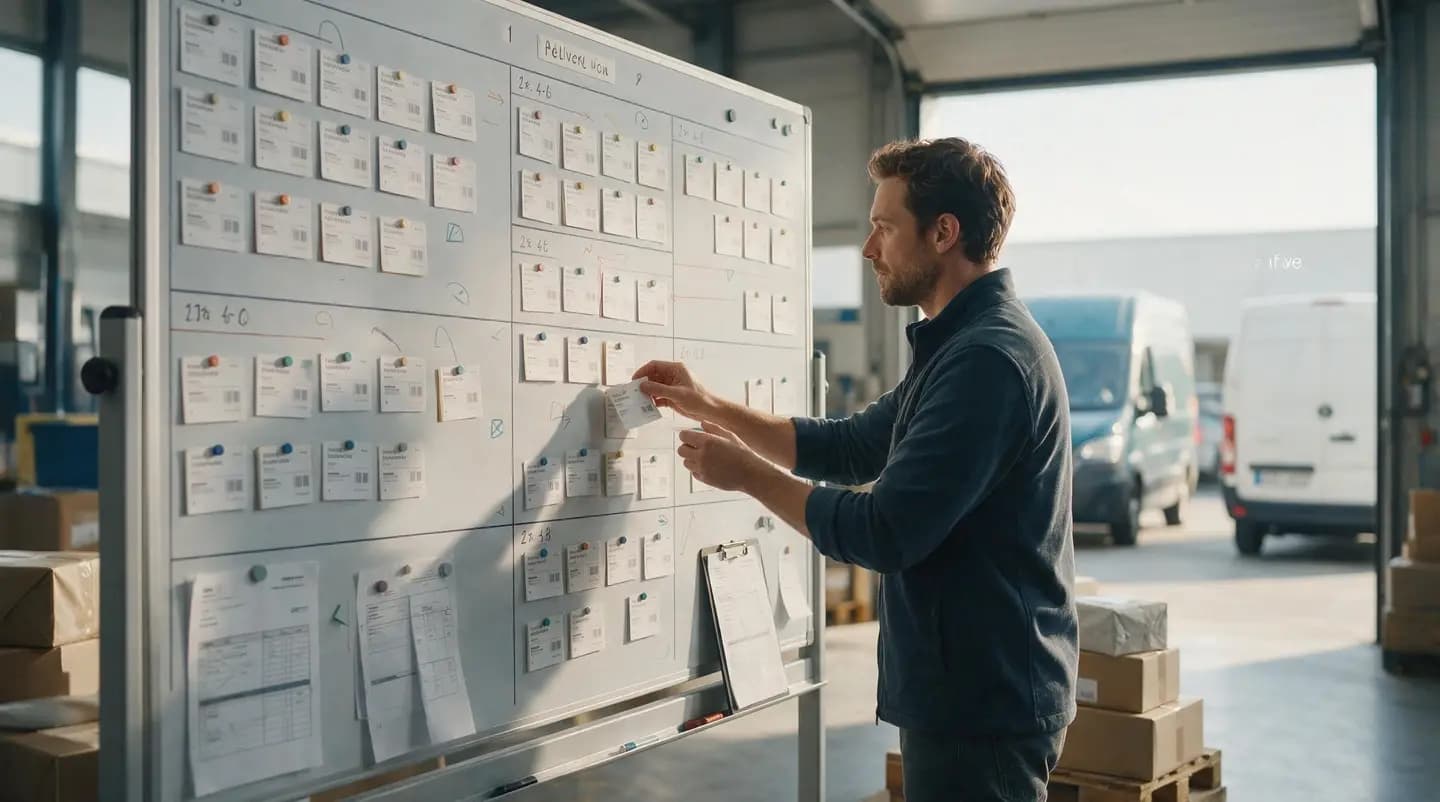
With a small number of orders, a planner can weigh up most of this by hand and get a good result. The difficulty is that the possible combinations grow quickly. Add more orders, more vehicles and more time windows, and it becomes very hard to judge every option manually within the time you actually have each morning.
Common route planning mistakes
A few patterns come up again and again when routes are planned under pressure:
- Judging routes on distance alone, and ignoring travel time and time windows.
- Splitting orders evenly across vehicles without looking at capacity.
- Checking time windows too late, once the route is already built.
- Overlooking vehicle capacity and overloading a vehicle.
- Forgetting the return trip to the depot at the end of the day.
- Relying on a fixed stop sequence, usually the order the orders arrived in.
- Planning to the map instead of to the whole working day.
How PrimoRoute helps
PrimoRoute is a route planning and transport management platform for transport and delivery businesses. It brings route planning and the wider transport operation together, so orders, vehicles, drivers and routes sit in one place instead of across separate tools.
PrimoRoute helps planners turn orders and available vehicles into organized routes, taking relevant planning factors into account, including:
- Vehicle capacity.
- Time windows.
- Vehicle working hours.
- Route sequence.
- Return to the depot.
The planner stays in control throughout and can review and adjust the plan before it goes out. The aim is simply to cut the manual work, make better use of the fleet a business already runs, and produce routes that are practical to carry out.